

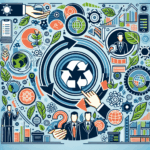
The discussion on corporate sustainability has focused, and with good reason, on climate change and the need to reduce carbon emissions. However, both science and a growing global awareness indicate that this is only part of a far more complex challenge. The loss of biodiversity and the linear model of production and consumption, characterized by the idea of “extract, produce, use, and throw away,” represent parallel crises that threaten the stability of our ecosystems and economies. It is in this context that the future ISO 14001 standard is preparing to integrate a more holistic view of sustainability.
The explicit inclusion of fundamental themes such as the circular economy and biodiversity protection within the context of environmental management represents an opportunity for companies to go beyond mere waste and emissions management. It invites organizations to radically rethink their processes and, in many cases, their very business model.
**Towards a Circular Economy**
Integrating the circular economy into a certified Environmental Management System means going beyond the traditional concept of recycling. It is crucial to consider the entire lifecycle of products from the design phase. Companies are encouraged to ask fundamental questions: How can we design products that last longer, are easily repairable, disassemblable, and reusable? How can we transform our products into services by adopting models like “product-as-a-service”? How can we establish closed loops in which the waste from one process becomes raw material for another?
This approach not only reduces environmental impact but also creates extraordinary opportunities for innovation, cost reduction, and customer loyalty. Companies that embrace these principles can position themselves as market leaders by proactively responding to environmental challenges and consumer expectations.
**Biodiversity Protection**
At the same time, considering biodiversity requires organizations to assess their impact on ecosystems, even beyond their own boundaries. This involves a thorough analysis of the supply chain, examining the origin of raw materials and the impact of their extraction. Becoming aware of the impact of business operations on land use, water resources, and natural habitats is of fundamental importance. For many companies, this represents a new frontier that entails acquiring skills and forming strategic alliances.
Expanding one’s perspective in this way is both a challenge and a necessity. Companies that first embrace circular business models and demonstrate a tangible commitment to biodiversity protection will not only improve their environmental performance but also build more resilient business models. Such models will be less dependent on virgin raw materials and more in tune with the expectations of increasingly sustainability-conscious consumers and investors.
The ISO 14001 certification, supplemented by these new themes, will transform into a symbol of leadership and vision. It will not only verify compliance but will represent the organization’s capacity to thrive in an economy that must necessarily become regenerative and respectful of the planet’s ecological limits.
In conclusion, the journey towards sustainable and circular management is not an option, but a necessity for companies that wish to remain competitive in the future. All of us can play a fundamental role in this process by adopting more sustainable practices and promoting positive change.
We invite you to follow us on our social media profiles to stay updated on the latest news regarding sustainability and to discover new opportunities for innovation and responsible growth together. Your participation is essential in building a better and more sustainable future.