

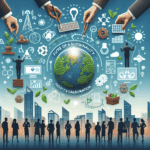
**The Future of Sustainability: Towards an Integrated Ecosystem of Tools, Investments, and Partnerships**
In recent years, the topic of sustainability has emerged as a central issue in public discourse and corporate strategies. A careful analysis of news from specialized portals reveals a rapidly evolving sustainability ecosystem, characterized by three main drivers: tools, investments, and partnerships.
The first driver is represented by tools. The technological landscape is evolving quickly, offering companies an increasingly sophisticated range of software platforms dedicated to the collection, management, and reporting of environmental, social, and governance (ESG) data. These tools not only simplify the data collection process, but they also leverage artificial intelligence to analyze vast volumes of unstructured information. This allows for timely identification of risks along the supply chain and real-time monitoring of corporate reputation. The transformation of ESG reporting from a mere manual and occasional exercise to an integrated and continuous process represents a significant step towards greater transparency and accountability.
Moving to the second driver, that of investments, there is a growing trend in capital flows towards strategies that integrate ESG criteria. This trend is manifested in the proliferation of financial products such as green bonds and impact funds. These instruments aim not only to generate economic returns but also to create a positive and measurable social or environmental impact. Institutional investors, in particular, are sharpening their involvement, using their position as shareholders to promote more sustainable practices among companies. The growing awareness of the importance of responsible investing is changing how companies and investors interact, creating an increasingly profound synergy.
The third driver is that of partnerships, a crucial element in addressing contemporary global challenges. Issues such as climate change and biodiversity loss require a collaborative and integrated approach, as no single actor can solve these problems in isolation. New collaborations among businesses, governments, non-governmental organizations (NGOs), and academic institutions are emerging with the intent to develop innovative solutions. These alliances aim not only to define common standards but also to drive the transition to a more sustainable global economy.
The synergy among these three pillars—tools, investments, and partnerships—is giving rise to a dynamic and interconnected ecosystem where sustainable practices are no longer an option but a necessity. Technological innovations and new market dynamics are shaping a future in which economic, social, and environmental decisions are increasingly integrated.
This era of sustainable enthusiasm brings with it numerous stimuli and opportunities. Companies that embrace this philosophy not only contribute to a more sustainable world but can also derive tangible economic benefits. It is essential for every actor in the private and public sectors to recognize their role in this process, advocating for policies and practices that support a responsible and fair economy.
Therefore, it is essential to actively commit to this transition, embracing innovation and collaboration as key tools. The future of sustainability is built on conscious choices and collective actions, and every single contribution counts.
In conclusion, the journey towards integrated sustainability lies in combining technology, finance, and cooperation. We invite readers to follow our social media profiles to stay updated on the latest news and insights regarding this crucial issue for our future. Sustainability is a shared responsibility, and collaboration is the key to realizing it.