

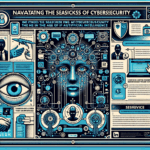
The interaction between artificial intelligence (AI) and cybersecurity is leading to an extremely complex and constantly changing situation. Companies are experiencing a sort of strategic “seasickness.” This expression perfectly captures the disorientation and confusion that many Chief Information Security Officers (CISOs) and business leaders feel in the face of AI’s contradictory nature.
On one hand, artificial intelligence represents a formidable resource for security, thanks to highly advanced defensive tools. With sophisticated algorithms, it is possible to analyze vast amounts of data to identify anomalies and potential threats in real time, automate incident responses, and even predict possible attack vectors. This means that companies can significantly strengthen their security posture by using AI as an ally in protecting themselves from malicious intrusions.
At the same time, AI has taken on a disturbing dimension, becoming a powerful tool in the hands of attackers. Generative AI, in particular, has the ability to produce phishing emails that are nearly indistinguishable from legitimate communications. This technology can develop polymorphic malware that can evade traditional detection systems, making life difficult for cybersecurity professionals. Additionally, it is possible to orchestrate large-scale disinformation campaigns, amplifying the reach of deception.
This situation creates a true dilemma for businesses. Ignoring the defensive potential of AI can mean falling behind and becoming easy targets for attackers. On the other hand, adopting artificial intelligence without a clear plan and the necessary expertise poses enormous risks. Companies find themselves navigating a stormy sea, where “AI-washing” solutions—products that claim to be AI without providing real benefits—are commonplace. Furthermore, the shortage of specialized talent in this field and the high cost of required skills certainly do not make the landscape any easier.
An additional problem arises from the security risks associated with AI models themselves, such as data poisoning or prompt injection, which are often poorly understood even by industry experts. This strategic “seasickness” can lead to hesitant adoption or, even worse, misguided and unfruitful investments.
Overcoming this phase of confusion requires not only a thorough technical assessment but also a well-defined strategy. It is essential to establish how AI can genuinely enhance an organization’s security posture. This process begins with identifying concrete use cases and gradually and consciously developing internal skills.
Ultimately, companies must pragmatically address the opportunities and challenges presented by artificial intelligence in cybersecurity. The key to effective cybersecurity risk management lies in an informed and strategic approach, supported by adequate preparation and ongoing staff training. Open dialogue within organizations is necessary, where skills can be shared and expanded.
We invite readers to stay updated on these topics by following our social media profiles. Here, you will find resources, updates, and the opportunity to connect with industry professionals. Cybersecurity and artificial intelligence are more than ever at the center of contemporary debate, and you won’t want to miss the latest developments.